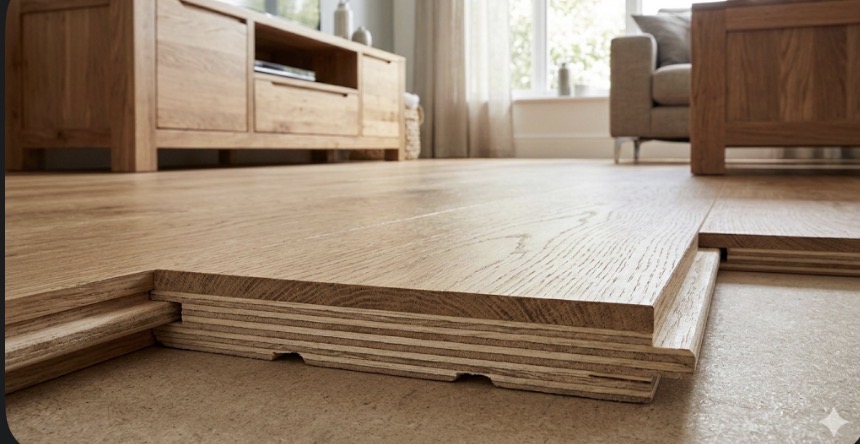
What brushing actually does
A wire brush is run along the board to remove the softer early wood between the grain lines, leaving the harder grain slightly proud. The result is a shallow, natural texture you can feel with a palm. It is not distressing and it is not artificial — it exaggerates what the tree already produced.
Scratch visibility
This is the practical argument. A smooth, uniform surface shows a single scratch as a bright line across an otherwise flat plane. A brushed surface already has variation, so light scuffs and claw marks disappear into the texture. In houses with dogs, children or a busy hallway, brushed oak looks better for longer without any change in how you clean it.
- Brushed + matt lacquer: the most forgiving everyday combination
- Smooth + gloss: the least forgiving; every mark shows
- Hand-scraped: hides damage well but reads strongly period or rustic
Cleaning and feel
Brushed boards hold a fractionally greater amount of dust in the grain, which a vacuum removes without difficulty; a damp microfibre mop finishes the job. They also give slightly better grip underfoot, which matters on stairs and in hallways where people come in from the rain. Smooth boards are marginally faster to wipe and feel sleeker barefoot.
How texture interacts with finish
Oil sits into a brushed surface beautifully and can be spot-repaired; lacquer sits over the top and gives a harder, more uniform film. A matt lacquer over brushed oak is the specification we fit most often in family homes because it combines forgiving texture with a wipeable, low-maintenance surface.
Which suits your room
Period homes, kitchen-diners and anything with heavy traffic suit brushed. Minimal contemporary interiors, particularly with pale finishes and large-format joinery, often look sharper in smooth. Neither costs meaningfully more than the other in our supply-and-fit pricing — this is a taste and durability call, not a budget one.