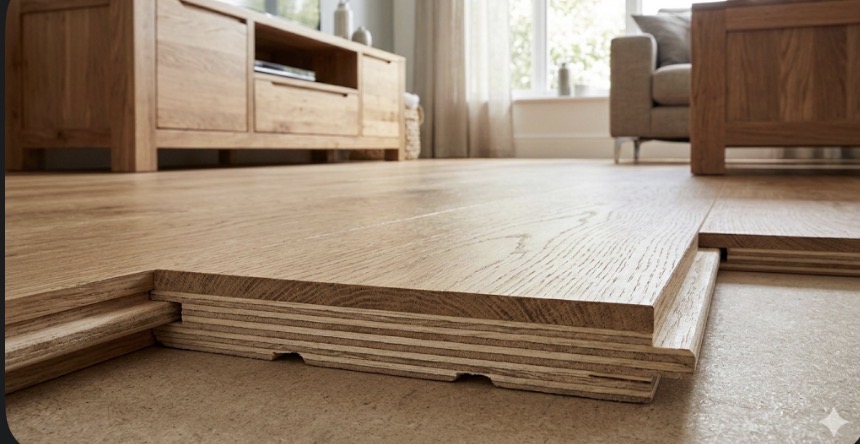
Glue-down
The board is fully bonded to the subfloor with a flexible adhesive. It feels solid underfoot, has no hollow echo, and conducts heat efficiently — which is why it's our default over underfloor heating. It also holds parquet patterns dead still, so herringbone and chevron are always bonded.
Floating
The floor sits on an underlay and is held by its own click or tongue-and-groove joints, not fixed to the base. It's quicker, cheaper to install and easily lifted. On upper-floor flats it's often the only way to hit a lease's acoustic requirement without building the floor up.
How the subfloor decides
A screed with a heating loop in it can't be nailed into, so glue-down or floating are the options. A springy timber subfloor may need overboarding before either method. We take moisture readings and a flatness check on every survey before recommending a build-up.
- Glue-down needs a sound, dry, flat base — latex screeding is common
- Floating needs a compatible underlay and expansion gaps at every perimeter
- Threshold height often rules out a build-up before anything else does
Repairs and lifting
A floating floor can be unclipped and re-laid, which matters if you may need access to services underneath. A bonded floor is a bigger job to lift, but it will not creak at the joints or move under a heavy kitchen island.