Moisture testing comes first
Every survey includes moisture readings. A screed that hasn't dried, or a solid floor without a membrane, will destroy a wood floor from underneath long after the fitters have left. Where the readings demand it, a damp-proof membrane goes into the quote — and where they don't, it doesn't.
Latex screeding and levelling
A self-levelling compound creates the dead-flat base LVT and bonded wood need. It's the most common preparation line on our quotes, particularly for LVT, where a dip over about 3mm telegraphs through the plank within months.
Ply decks and overboarding
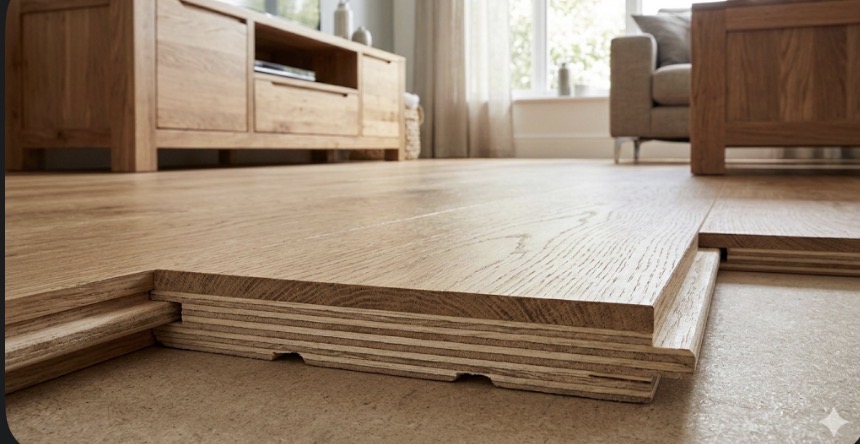
Solid wood is secret-nailed to ply, so a ply deck is built where the base is screed. Overboarding is used on tired or slightly springy timber decks to give a sound, flat surface. Both add height, so we check door and threshold clearances at the same time.
- Moisture readings — always, at survey
- DPM — only where readings require it
- Latex screed — flatness driven, most common on LVT
- Ply deck — where solid wood meets screed
- Overboarding — where the existing deck moves
What happens when it's skipped
The four failure modes we get called to are always the same: dips telegraphing through vinyl, hollow spots and movement under bonded boards, cupping from a damp base, and pattern floors drifting off a base that wasn't flat. None of them are cheap to correct afterwards.