£150 OFFthis month —Claim now →
SUPPLY & FIT · LONDON · SUSSEX · SURREY

MATERIAL COMPARISON

Engineered wood vs solid wood flooring

Both are real oak on the surface, so the choice is rarely about looks — it is about how the board is built and what your subfloor and heating are doing underneath it. This is the comparison we walk customers through on survey, in the same order we'd cover it in person.

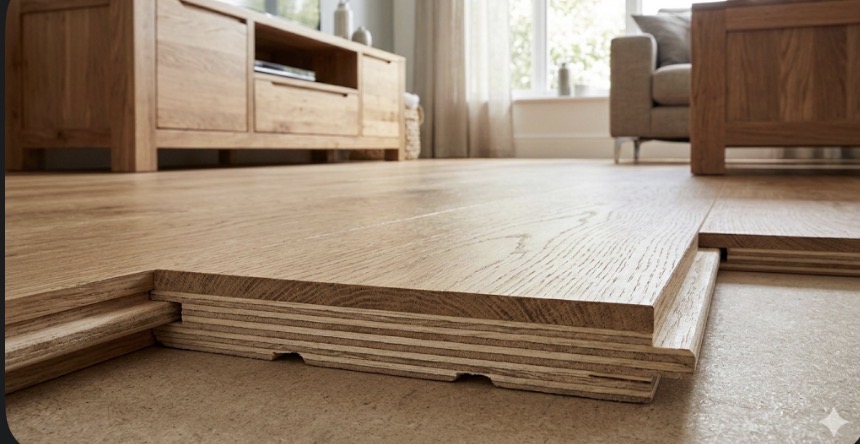
Wide-plank engineered oak flooring fitted in an open-plan room

How the two boards are actually built

Solid wood is one piece of timber all the way through, usually 18–20mm. Engineered wood is a real oak wear layer (typically 3–6mm) bonded to a cross-ply or HDF core. That core is the whole argument: cross-bonded plies pull against each other so the board barely moves with humidity, while a solid plank expands and contracts across its width every season.

Underfloor heating decides it for most people

If you have wet underfloor heating, engineered is the answer and solid is not. Solid timber over a heated screed cups, gaps and, on wide planks, can delaminate a finish. We will not quote solid over wet UFH — if a survey shows heating in the screed, the quote comes back as engineered.

Re-sanding life

A solid board can be re-sanded several times across its life, which is why original Victorian pine is still in service after a century. A 6mm-wear-layer engineered board takes one, sometimes two, careful re-sands. If the floor is going into a house you intend to keep for decades and there's no UFH, that longevity argument favours solid.

  • Solid oak: 20–40 years with one or two re-sands across its life
  • Engineered oak: 20–30 years with a re-sand around year 12–15
  • Wear-layer thickness matters more than total board thickness

Subfloor and fitting method

Solid is normally secret-nailed to ply, which means building a ply deck if you're on screed — extra height and extra cost. Engineered can be fully glued to screed, floated on acoustic underlay, or nailed. On flats with acoustic requirements or on a low door threshold, that flexibility often settles the decision before price does.

Fitted cost

Our supplied-and-fitted pricing starts at £59/m² for engineered oak and £72/m² for solid wood, before subfloor works. Solid also tends to carry more prep cost because of the ply deck. On a like-for-like room, engineered is usually the cheaper finished floor even when the board itself isn't much cheaper.

Side-by-side summary

Engineered oakSolid oak
Wet underfloor heatingSuitableNot recommended
Wide planks (190mm+)StableHigher movement risk
Re-sandsOne to twoSeveral
Typical fittingGlue-down, floating or nailedSecret-nailed to ply
From (supplied & fitted)£59/m²£72/m²

Frequently asked

Does engineered wood look cheaper than solid?
No — the visible surface is the same species and the same finish. Once fitted and skirted, most people cannot tell them apart without lifting a board or looking at a cut edge.
Can I put solid wood in a kitchen?
You can, but we usually steer people to engineered or LVT there. Kitchens combine spills, appliance leaks and often UFH, all of which are harder on a solid board.
Which is better for a first-floor flat?
Engineered, almost always. It floats over an acoustic underlay to meet lease requirements without building extra height into the floor.
Do both need acclimatisation?
Yes. We acclimatise both to room temperature and humidity before the first board goes down, and we take moisture readings on the subfloor at survey.

In short

Engineered wood wins on underfloor heating, wide planks, screed subfloors and finished cost. Solid wood wins on lifetime re-sands in a period home with a timber subfloor and no UFH. Everything else — species, finish, plank width, look — is available either way.

Not sure which board suits your subfloor?

We take moisture readings and give you a written quote within 48 hours.

4.9

Trustpilot

210+

4.9

Google Reviews

140+

9.8/10

Checkatrade

Vetted

BOOK YOUR FREE SURVEY

READY TO
FIT YOUR DREAM FLOOR?

Our flooring experts are here to help. Book a free on-site survey and get a no-obligation quote within 48 hours.

Get Free Quote →