£150 OFFthis month —Claim now →
SUPPLY & FIT · LONDON · SUSSEX · SURREY

SYSTEM COMPARISON

Flooring over underfloor heating: what actually works

Underfloor heating narrows the options fast, and getting it wrong shows up as cupping, gapping or a system that never quite warms the room. Here's how each floor type behaves over a heated build-up.

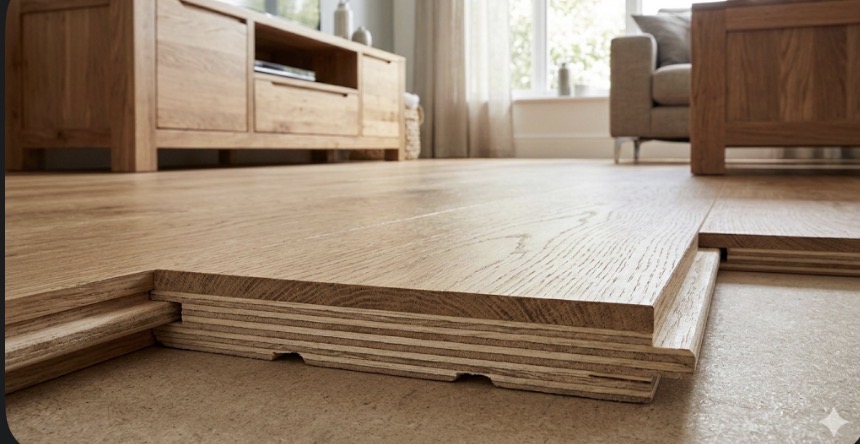
Wide-plank engineered oak over an underfloor-heated screed

Engineered wood — the default

A cross-bonded core stays dimensionally stable through the heating cycle, and fully bonding it to the screed gives the best heat transfer. This is what we specify for the large majority of UFH projects, and it's why our engineered oak sits at the centre of extension and new-build work.

LVT and SPC — good, within limits

Vinyl conducts heat well and is comfortable underfoot, but every product has a maximum surface temperature. We check the manufacturer's limit against the system design at survey. The usual constraint isn't the vinyl, it's the flatness of the screed underneath it.

Parquet — yes, in engineered form

Engineered herringbone and chevron are fitted fully bonded over heated screed. Solid blocks are not something we'd put over a wet system: too many small pieces, too much cumulative movement.

Solid wood — no

Solid timber moves too much over wet underfloor heating. If a survey finds heating in the screed, our quote comes back as engineered rather than solid. This isn't a preference — it's the difference between a floor that lasts and a callback.

  • Commission and run the heating before the floor goes down
  • Insulating underlays cut output — build-up is part of the design
  • Ramp the system up gradually after installation, not straight to full

Build-up and thresholds

Every layer between the pipe and your feet slows the system down. We keep the build-up as thin as the acoustic and levelling requirements allow, and we check door and threshold heights on survey so nothing has to be trimmed later.

Suitability over wet underfloor heating

FloorOver wet UFHNote
Engineered woodRecommendedFully bonded for best conduction
LVT / SPCSuitableRespect the surface temperature limit
Engineered parquetSuitableBonded, never floated
Solid woodNot recommendedExcessive seasonal movement

Frequently asked

Does electric UFH change the answer?
Electric mats sit closer to the surface and heat faster, so surface temperature limits matter even more. The material ranking is the same.
Can I keep my existing boards and add UFH?
Sometimes, with an overlay system, but it depends on joist depth and finished floor height. It needs a survey, not a phone estimate.
Will a rug damage the floor?
A large, thick rug traps heat locally. We advise on placement at handover rather than banning them outright.
How long before we can run the heating at full output?
The system is ramped gradually after installation. We set out the exact schedule in the aftercare pack for the specific floor supplied.

In short

Engineered wood bonded to the screed is the safe answer, LVT and engineered parquet work within their temperature limits, and solid wood doesn't belong over a wet system. Build-up thickness and screed flatness matter as much as the board you pick.

Heating already in the screed?

Moisture readings, surface temperature limits and build-up checked on site.

4.9

Trustpilot

210+

4.9

Google Reviews

140+

9.8/10

Checkatrade

Vetted

BOOK YOUR FREE SURVEY

READY TO
FIT YOUR DREAM FLOOR?

Our flooring experts are here to help. Book a free on-site survey and get a no-obligation quote within 48 hours.

Get Free Quote →