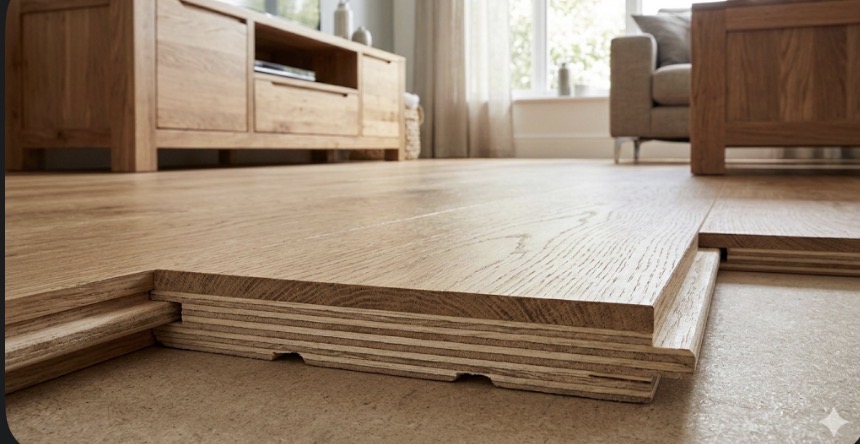
How each joint works
A traditional tongue-and-groove board has a straight tongue that slots into a matching groove; it relies on glue, nails or the weight of the floor to stay closed. A click profile is machined with an angled or drop-lock geometry so boards mechanically hold each other closed with no adhesive in the joint at all. Click is a modern manufacturing achievement — the tolerance on those profiles is tighter than most people imagine.
Fitting method
Click floors are designed to float over underlay and go down quickly, which is why they dominate the DIY market. Tongue and groove can be floated with glued joints, secret-nailed to a timber subfloor, or fully bonded to screed. If your specification calls for full adhesive contact — herringbone, wide planks, acoustic requirements in a flat — tongue and groove is generally the cleaner route.
- Click: fast, floating, liftable, no adhesive in the joint
- T&G: nailable and fully bondable, better for wide planks and parquet
- Some engineered ranges offer both profiles on the same decor
Lifting and reusing
A floated click floor can be lifted board by board and relaid, which is genuinely useful in a rental, over a suspect subfloor, or where a lease might require the floor to come up. A glued or nailed tongue-and-groove floor comes up in pieces. If access to services beneath the floor is likely, say so at survey — it changes what we specify.
Behaviour over underfloor heating
Over wet UFH, a fully bonded board conducts heat better and moves less than a floated one, because there is no insulating air gap or thick underlay between the board and the screed. That is why we generally recommend a glue-down tongue-and-groove or a glueable click over heating, with a thin thermally-rated underlay if floating is unavoidable.
Which to choose
For most domestic engineered oak floors laid over a flat, dry screed, a glue-down installation gives the most solid, quietest, longest-lived result regardless of profile. Click is the right answer for speed, for lift-and-relay flexibility, and for rooms where the subfloor is not perfect and a floating floor bridges the imperfections.