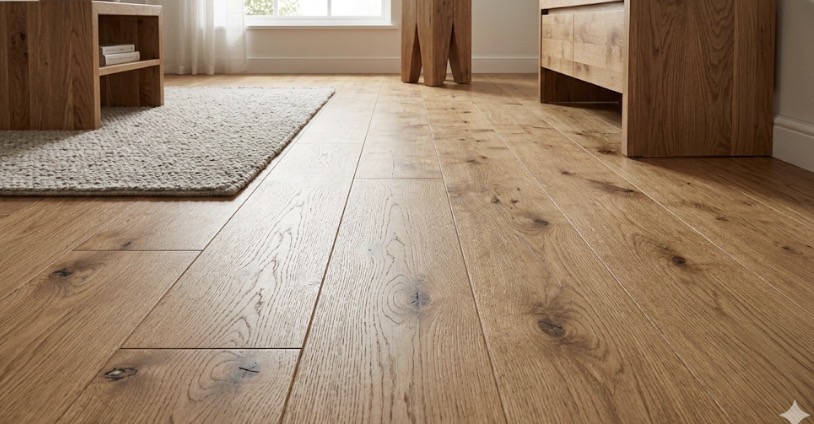
Hardness and everyday durability
European oak sits around 1,120 on the Janka scale; American black walnut is closer to 1,010. Walnut is a genuinely softer timber, so it dents more readily under furniture legs and dropped pans. It is not fragile — plenty of walnut floors are decades old — but in a kitchen-diner with stools scraping back twice a day, oak takes the punishment better.
Colour, and how it moves
Walnut arrives a deep chocolate brown with purple and grey undertones, and it lightens in daylight. Over a few years a walnut floor near a south-facing window will visibly mellow, and anything left standing on it can leave a lighter or darker ghost. Oak does the opposite — it ambers slightly with age, which most people read as improvement. If you have large glazed doors, this is worth thinking about before you commit.
- Walnut: lightens with UV exposure; move rugs occasionally to even it out
- Oak: warms and ambers, particularly under an oiled finish
- White or grey-toned oaks are the most colour-stable option
Availability and plank width
Oak is available in almost any width, length, grade and finish you can name, including 220mm-plus wide planks and full herringbone ranges. Walnut is a narrower market: fewer ranges, generally shorter and narrower boards, and longer lead times on anything unusual. If you want a wide-plank walnut in a hurry, expect to wait.
Cost
Walnut carries a premium of roughly 15–30% over an equivalent oak specification, and the gap widens on wide planks. Our engineered oak starts at £59/m² supplied and fitted; walnut is quoted per range. Where budget is tight and the client wants dark, a smoked or stained oak achieves a similar tone at oak pricing and oak durability.
Where each belongs
We fit walnut in living rooms, studies, principal bedrooms and dining rooms — spaces where the floor is admired more than abused, and where a dark, warm tone suits the joinery. Oak goes everywhere else, and particularly through open-plan ground floors where one continuous species has to serve a kitchen, dining area and sitting space at once.