Hide, don't fight
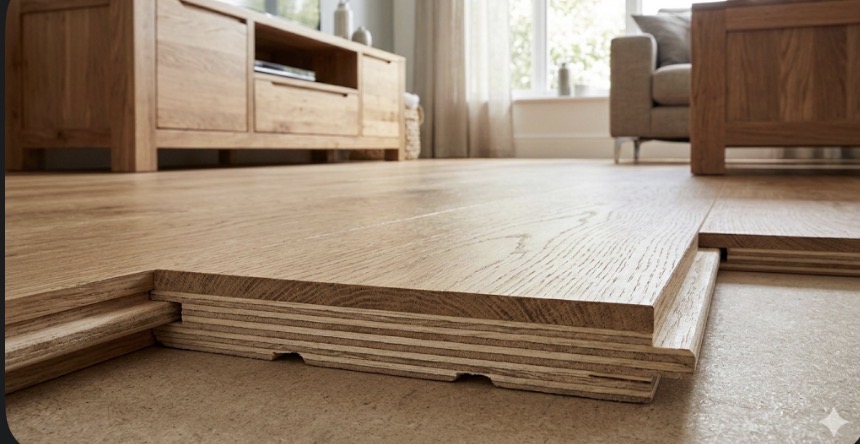
Every family floor collects marks. The variable is whether you see them. A brushed, matt-finished oak in a mid tone hides scuffs, crumbs and small dents remarkably well; a high-gloss dark floor shows every footprint and every scratch from the moment it is laid. Choosing texture and sheen well matters more than choosing the hardest available product.
Noise and warmth
Hard floors amplify a house full of children, particularly upstairs. A dense acoustic underlay under a floated floor, or a fully bonded installation, both cut impact noise significantly. Wood and LVT are warmer underfoot than tile, which matters a great deal when a toddler spends most of the day on the floor.
- Bonded floors are the quietest — no cavity to drum
- Acoustic underlay is essential in flats and worth it in houses
- Large washable rugs in play areas take the worst of the wear
Spills, and what they do
Juice, paint, felt tip and potty training accidents are the reality. LVT shrugs all of it off. A lacquered engineered oak handles it if wiped within a reasonable time. Oiled floors are the most vulnerable to standing liquid but the easiest to spot-repair afterwards. Standard laminate is the worst of both worlds: it stains at the joints and cannot be repaired.
Safety
Matt and brushed surfaces give better grip than gloss, particularly in socks on stairs. Avoid high-shine finishes on landings and staircases entirely. Threshold strips should be flush or ramped rather than proud — they are the thing small children trip on most, and they are easy to get right at specification stage.
Repairability is the real test
Something will happen: a dragged toy box, a dropped scooter, a leaking radiator. On a real wood floor, a plank can be replaced or a room re-sanded and re-finished from £28/m². On LVT, a single plank can be swapped in an hour. On laminate or carpet, damage generally means living with it or replacing the room. That is why we steer family homes towards wood and LVT.
A sensible whole-house plan
Bonded LVT or engineered oak downstairs where the traffic and the spills are; engineered oak or carpet in bedrooms; nothing glossy anywhere. Budget a contingency for a re-finish around year eight rather than a replacement, and the floor comfortably outlasts the phase of life that tested it.